
A suturing technique that has dominated microsurgery for over a century now has a bioinspired challenger. On November 13, a team led by Professor Zeng Wen at the Army Medical Center of the Army Medical University (Daping Hospital), working with Professor Xing Mengqiu's team at the University of Manitoba, published in Science an integrated microneedle interlocking adhesion system, or iMAS, inspired by how plant roots anchor into soil. It merges rapid vessel anastomosis, wireless real-time monitoring and AI analysis into one strategy for vascular reconstruction and post-operative care. In a rat common carotid artery model, iMAS cut mean anastomosis time from 38.83 minutes with conventional suturing to 8.59 minutes, a reduction of about 78 percent.
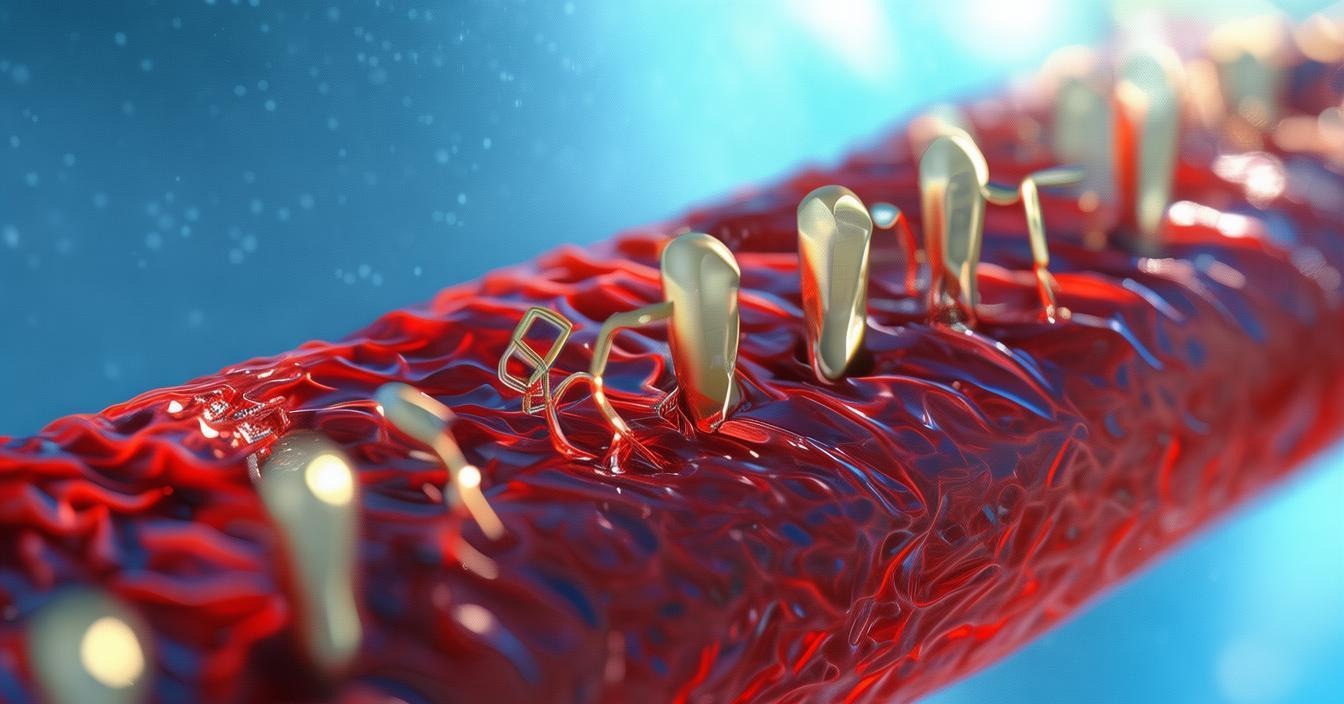
iMAS combines a hydrophobic adhesive matrix with 3D-printed four-arm microneedles: the matrix displaces fluid on the vessel surface to form bonding, while the microneedles lock into the vessel wall in three dimensions the way roots grip wet soil, sealing a wet, pulsating surface quickly and firmly. Experiments on pig vessels confirmed feasibility on small vessels; ten months after surgery, treated vessels maintained stable flow, with significantly reduced intimal hyperplasia at the junction.
The other half is post-operative intelligence. The team integrated a passive wireless resonant sensor with deep-learning algorithms, tracking hemodynamics continuously and noninvasively through signal shifts caused by vessel pulsation. In an allogeneic heart transplant model, the system monitored the transplanted heart's beat for three months, distinguishing and predicting graft survival versus failure from signal amplitude, waveform and rhythm. Anastomosis thereby extends from a single operation into continuous post-operative monitoring.
Since vascular anastomosis was pioneered in 1902, micro-suturing has depended on the surgeon's skill, consumed long operating time and risked endothelial damage, while thrombosis and stenosis threatened long-term patency. iMAS reduces that dependency, with listed uses ranging from rapid battlefield vessel repair to casualty transport monitoring. Appearing in Science rather than a specialty journal also signals that this materials-plus-device-plus-AI route is being taken seriously by mainstream academia.