
On October 21 local time, NVIDIA CEO Jensen Huang delivered the keynote at GTC Berlin. Amid a stress test for AI assets, his answer centered on two words—efficiency and speed: less power, shorter build times, tokens to revenue faster. The heavyweight launch was DSX POD, a modular delivery scheme for complete Vera Rubin AI factories.
1. From selling chips to shipping “container AI factories”
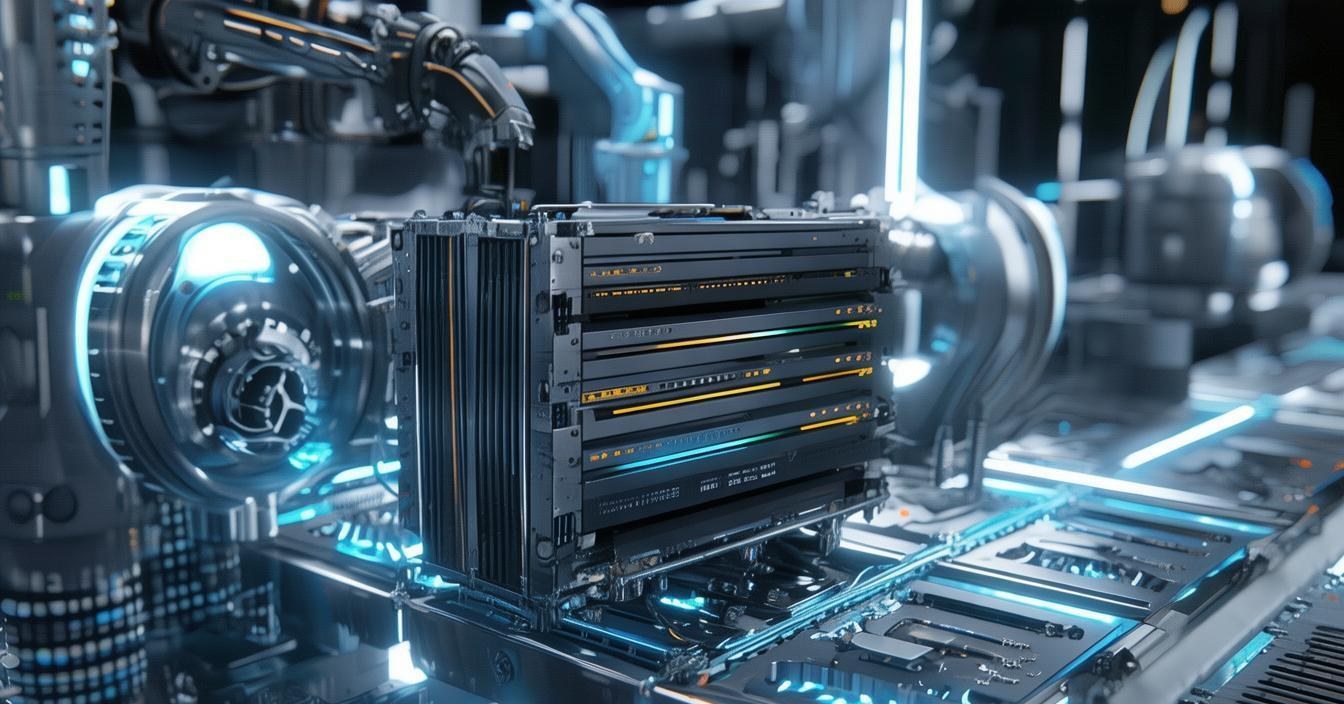
Huang stressed that “an AI factory creates value only when it starts producing tokens.” The economics: a 1-gigawatt AI factory costs about $50 billion to build and may generate roughly $40 billion in annual revenue, while a three-month delay can mean about $10 billion lost. DSX POD's answer: ① each POD packs seven liquid-cooled racks and about 17 km of Spectrum-X cabling on 800-volt DC power; ② compute, networking and liquid-cooling are integrated and validated at the factory; ③ with site utilities ready, deployment shrinks from about six months to as fast as 14 days, with Dell, HPE, Lenovo, Foxconn and Quanta delivering from early 2027. “The container itself is the AI factory.”
2. Vera Rubin in full production, throughput jumps again
The new platform came with dense numbers: ① over 11 years, extreme co-design has lifted NVIDIA's AI performance a million-fold; ② Vera Rubin is now in full production, with each node assembling in under 5 minutes versus 2 hours for Grace Blackwell—over 24x faster; ③ on agent workloads, the Vera Rubin NVL72 system delivers 30x the per-megawatt throughput of the Blackwell generation. The supply chain is scaling in step: substrate capacity will grow to 2.5x within three years, and Amkor plans to expand advanced packaging capacity by over 300% by end-2028.
3. The Europe push: towers become compute nodes
Europe anchored the keynote: ① NVIDIA invested nearly $10 billion in Europe last year alone, working with over 12,000 partners; ② Huang had earlier appeared with German Chancellor Merz to announce an industrial AI pact involving Siemens, Audi and a dozen-plus German firms, building industrial models for robotics and autonomous driving on Nemotron and Cosmos; ③ telecom networks are the new compute frontier—T-Mobile completed the world's first commercial AI-RAN call, with Deutsche Telekom, BT and Elisa piloting, so “telco towers may evolve into a distributed AI network.”
4. Agent safety: “Prayer is not security”
On agent overreach, Huang was blunt: “The only thing preventing agents from abusing permissions today is politely asking them not to—prayer is not security; security is an engineering problem.” NVIDIA launched the OpenShell reference architecture combining Vera Rubin infrastructure, the Vera CPU, BlueField-4 DPUs and a secure runtime for agent isolation and behavior monitoring, with Anthropic, OpenAI, Microsoft and AWS participating.
AI infrastructure competition is shifting from “how big you build” to “how fast you earn”—delivery speed itself is becoming part of the compute product.
5. Watch: the efficiency narrative still awaits orders
After a round of stress on AI assets, investors want deployment evidence, not another roadmap: hyperscalers at scale, real declines in per-token inference cost, capex converted into durable returns. NVIDIA's pitch—less power, less water, shorter builds—still needs data to confirm. For China's government and enterprise compute builds, modular prefabrication, liquid cooling and workload-aware scheduling remain the certain path to efficiency—NineZenith designs intelligent-compute platforms with delivery time and energy metrics as first-class constraints.
(Sources: Cailian Press, Wallstreetcn, ThePaper, Sina Finance and other public reports)